

A redhead looks down at her arm, being held gently by her male companion. She runs her long fingers across the inside of her elbow. He rests his round chin sweetly on her forearm. They spend a lot of time together — that’s demonstrated by the way they fall and fit into one another’s crevices. They lean into each other; the soft side of an elbow becomes a pillow.
Bonnie and Kyle, two orangutans at the Smithsonian National Zoological Park in Washington, D.C., have been living together for six years. They share their quarters, the Great Ape House and the Think Tank, with four other orangutans, and onlookers are aplenty during visiting hours, but they’re not shy about their affection. Any volunteer who spends time with the orangs can tell you a story about having watched the two lovers engage in a romp. They do it out in the open for all to see. But sex is never simple. Not unlike humans, primate keeper Megan Anderson says with a smile, “they’re complicated.”
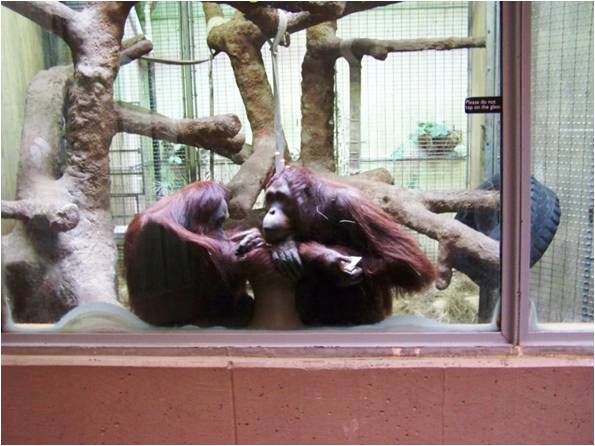
Bonnie and Kyle spend time together at the National Zoo in Washington, D.C. Photo by Michael A. Moreno
Kyle was brought to the National Zoo not to mate with Bonnie but to breed with bright-eyed Batang. Kyle and Batang are both Bornean orangutans, and both are 14 years old. Bonnie is a hybrid, a mix between Sumatran and Bornean, and she’s 20 years older than her beau. The Bornean and Sumatran species look very much alike and can be differentiated only through genetic analysis. The World Conservation Union’s Red List of Threatened Animals classifies the Sumatran orangutan as critically endangered and the Bornean as endangered. For more than a million years, the two species have been geographically separated by ocean. Both live most of their lives up in the lush rainforest canopy and almost always live out solitary existences. In the forest, pairs of adult orangs come together in times of plenty, when fruit abounds, and then mate and then go their own separate ways. But in captivity, things are different: Food availability is not an issue, and social connections, some long term, are often forged.
The orangutan’s natural habitat in Borneo in particular is disappearing at what researchers have described as an alarming rate and could be gone completely in the next two decades if illegal logging and forest clearing for agriculture continue at the current pace. In 1998, there were thought to be only about 12,000 orangutans left on the island, making the breeding of captive Bornean orangutans a matter requiring human intervention. The Species Survival Plan sanctioned by the Association of Zoos and Aquariums determines which captive orangutans should breed, and Kyle and Batang are on its list.
But how Kyle and Batang got matched up isn’t exactly straightforward.
“Batang was born at the Topeka Zoo and was transferred to us in 1996. She is, indeed, however, owned by Brookfield Zoo (in Chicago), just like Kyle was born at Cleveland Zoo but is owned by (Salt Lake City’s) Hogle Zoo,” Anderson explains. “Within the network of zoos, breeding is recommended to us. Once breeding occurs, it can get pretty complicated with who owns who. So, Batang was the result of a breeding recommendation at Topeka Zoo; therefore, one of her parents was from or owned by Brookfield; hence, she is also owned by Brookfield. She happened to be sent to us, for a breeding recommendation for her, Kyle.”
 It’s a wet weekend at the Great Ape House, and some of the orangutans are outdoors in the orang yard. A birthday party has just stormed in. The rustle stirs the smell of earth and nature, like fresh manure. Small children, with a scattering of parents and a zoo guide among them, move like a herd toward the gorillas housed across the room from the orangutans.
The children perform for the gorillas, shuffling sideways along the glass and slapping at the window with complete disregard for the “Great Ape Etiquette” signs posted throughout the facility. Not to be outdone, the silverback of the troop behind the glass moves powerfully across the length of his enclosure, embodying force and speed, and performs for the children.
Anderson, curly haired and sporty in her neutral zoo uniform, raises her voice above the squeals and laughter, explaining that Kyle is finally starting to show a signs of maturity. “He’s starting to vocalize long calls a little bit more and more,” she says. “I think, as that happens, he’s going to start seeing other females.”
Both males and females have throat pouches that make their calls travel long distances throughout the forest. Dominant male orangutans use loud, daily calls to make females aware of their presence – and availability. That Kyle is alive and well and one day will be able to make those calls is the result of human intervention, too. Not long ago, Kyle developed air-sacculitis, a respiratory and throat sac infection common to captive primates, particularly orangutans. “They think it is because captive orangutans spend much more time on the ground than wild ones would,” Anderson explains. “It is unlikely a wild orangutan would have gotten that same infection.”
When left untreated, air-sacculitis can cause pneumonia and often proves fatal, so Kyle underwent a course of antibiotics, and then the veterinary staff determined that to completely eliminate the source of the infection it was best to perform an ostomy, a surgical procedure that left a hole, or stoma, in the freckled flesh between his upper chest and throat. When Kyle hangs from his hands on the exhibit apparatus, the scar tissue stretches into a tall O, like the rim of a fleshy pie crust, but Anderson reassuringly insists that the stoma doesn’t bother him. “It actually has healed very well and has closed up some since the initial surgery,” she said. “The hope is that it will close up more over time, but it could take years.”
 Meanwhile, Batang has had at least a couple of sexual encounters with another orang in her midst – Kiko, who is Bonnie’s offspring and, thus, not breeding material. “Once she seemed nervous by it and was like, ‘Whoa, what just happened?’” Anderson says, but she figured it out soon enough. At 23, Kiko has long hair and full flanges, dark, disc-like cheek pads that denote maturity. In contrast, Batang’s intended mate, Kyle, still has short hair and the smooth, oval face of a youngster. Like the other female orangs living at the National Zoo, Batang is on birth control. Anderson says that, when the time is right, hopefully within the next couple of years, Batang will be separated from Kiko and the birth control discontinued. Then it’s just a wait-and-see situation. “I guess we’ll give it some time, and then we’ll recommend something else (if it doesn’t work). But I think it will be successful,” Anderson says.
For the time being, Bonnie and Kyle are free to have their way with each other, and Kyle seems to be happy with his older woman. Bonnie was born in December 1976 at the Albuquerque Zoo and arrived in D.C. just four years later. She’s a good fifty pounds heavier than Kyle, and has luxurious burgundy hair.
Even if Kyle and Batang do make a go of it one day and a new Bornean orangutan is brought into the world, it’s unlikely that the offspring will ever be reintroduced to the wilds of Borneo. Species survival plans like theirs are the options of last resort and implemented when conservationists believe captive breeding programs may be their only chance to beat extinction.
Today, 116 programs cover 172 species in North America. In the wild, female orangs give birth about every eight years and nurse their young up to six years, making population growth a slow process. Reversing the decline of orangutans in Borneo hinges largely on educating islanders and engaging them in conservation efforts. The 15 million people who live on Borneo, the third-largest island in the world, are mainly Maylays, Chinese and Dayak, and there are more than two dozen Dayak sub-ethnic groups, some of which are threatened by extinction themselves, with only between 30 to 100 representatives remaining. About three-quarters of Borneo is claimed by Indonesia, and about a quarter is claimed by Malaysia. It has one tiny sovereign state, Brunei.
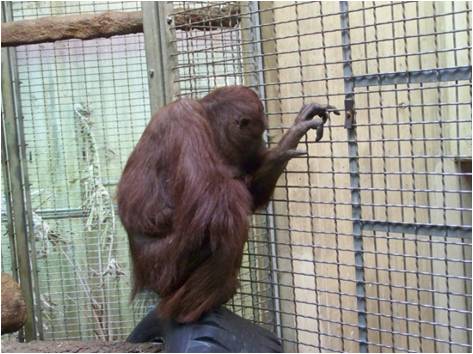
Kyle developed air-sacculitis, a respiratory and throat sac infection common to captive primates, particularly orangutans. Photo by Michael A. Moreno
Back at the National Zoo, the energetic birthday party attendees move toward the orangutan enclosure. The zoo guide describes the expansive reach of the animals’ arms – elongated muscles with a subtler strength than that of the gorilla’s squatty power thrusts, a strength required to spend so much of life up in the treetops. The kids watch the guide as she performs for them, stretching out her arms as far as she can. Inside the enclosure, Kyle climbs and swings alone, the scar on his chest stretching with each reach. He clings, with his long, rough and creased fingers, to the gray metal cage facing out into the orang yard, where Bonnie is basking in the sun.
Note from writer: This piece was composed this time last year. To find out more about the National Zoo’s orangutans, visit http://nationalzoo.si.edu/.
Filed under: Uncategorized
 morenoreads